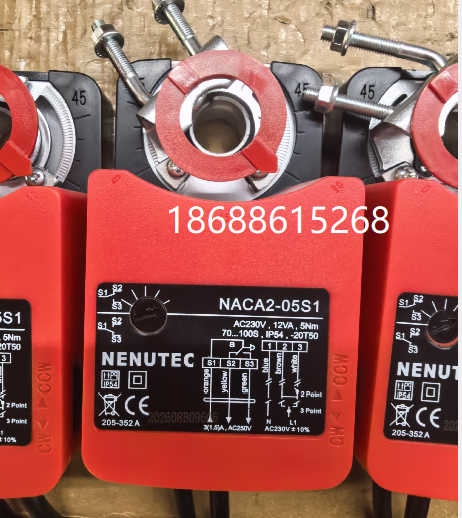
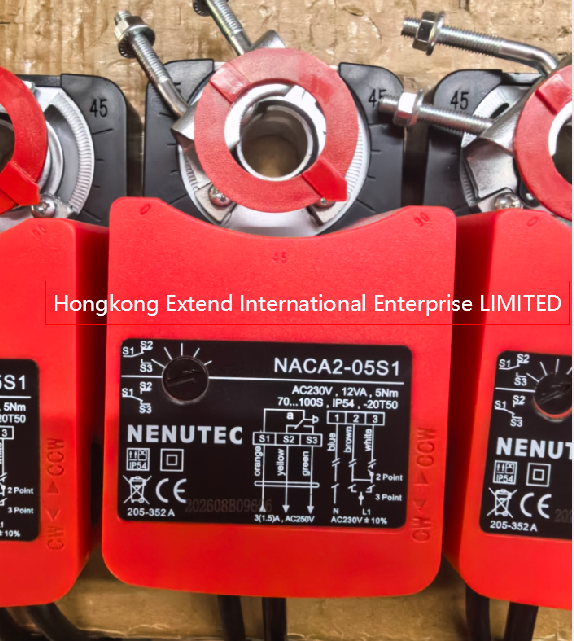
NENUTEC BRAY Actuator NACA2-05S1
![]()
The actuator is an essential and important component in industrial control, as well as a combination of actuator and control valve in automatic control systems. Its function is to receive control signals from the controller, change the size of the controlled medium, and maintain the controlled variable at the required value or within a certain range. In the field of robotics, actuators serve as the core components, equivalent to the joints and muscles of robots, and can directly determine the degrees of freedom and maneuverability of robots. two
For example, in wearable exoskeleton robots, actuators are attached to both legs and thighs, and their artificial intelligence can recognize and analyze the wearer's muscle movements in real time to provide assistance. four
In automotive artificial intelligence systems, actuators participate in the process of compressing photon inputs and associating them with outputs. For example, Tesla's fully autonomous driving (FSD) system associates photon input with actuator output to achieve human like driving behavior. three
According to their energy form, actuators can be divided into three categories: pneumatic, hydraulic, and electric. Pneumatic actuators use compressed air as an energy source, which is characterized by simple structure, reliable and stable operation, high output thrust, easy maintenance, fire and explosion prevention, and low price. Therefore, they are widely used in production processes such as chemical, papermaking, and oil refining, and can be easily matched with passive instruments; Even when using electric instruments or computer control, pneumatic actuators can still be used as long as the electrical signal is converted into a standard pressure signal of 20-100kPa through an electric pneumatic converter or electric pneumatic valve positioner. Electric actuators have convenient energy access and rapid signal transmission, but their structure is complex and their explosion-proof performance is poor. Hydraulic actuators are basically not used in production processes such as chemical and oil refining, and their characteristic is a large output thrust
![]()